
Crate training a puppy helps set both the puppy and owner up for success in training, and also provides a good safety tool for situations such as driving, busy family events, or emergency situations. All responsible rescue groups and responsible breeders begin the crate training process before you even bring your puppy home. So hopefully your puppy is no stranger to a crate. My puppy, who just turned 1 year old, was crate trained before coming to me, but that didn’t mean he initially embraced being in the crate at my house. We have worked hard on this process.
Crate training is a valuable skill, especially for puppies. A properly sized, secure puppy crate is the safest place for your puppy when you are not home, cannot supervise him or when the house is dangerously hectic (the puppy could escape!). All my puppies were familiar with a crate. Additionally, sometimes, such as during a natural disaster, a crate-trained dog can mean the difference between taking your dog to a safe place or not.
Safety tips for puppy crate training
Some important points to consider when using crates and ex-pens:
- Remove the collars when packing. This eliminates the possibility of a tag getting stuck in one spot in the crate and injuring the puppy.
- Take into account how long your puppy will stay in the crate when home alone. A general rule of thumb is 1 hour for each month of age. But that could mean 8 hours for an 8 month old dog, and I completely disagree with that. My own guideline is 4 to 5 hours, again depending on the age of the puppy, the time of day and what type of enrichment and exercise he has had before being crated.
- Your puppy’s crate should be in a room where you spend time with him regularly. Cellars or a room only used for the crate is not a good idea.
- Do not use the crate for punishment such as a time-out, etc. That creates the opposite of a positive association.
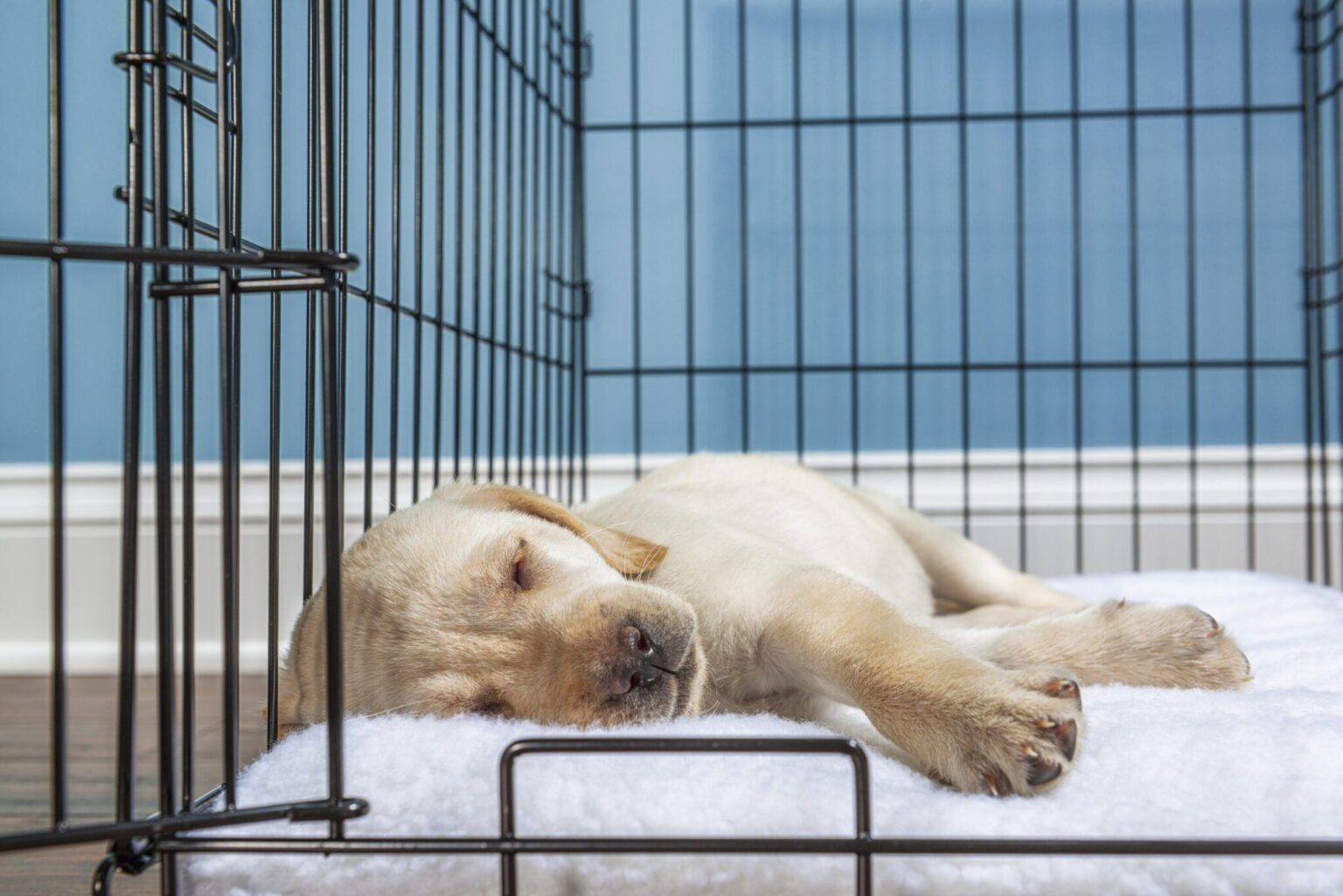
- Make the box to the right size. Most wire crates now come with a divider that can be completely moved or removed depending on the size of your puppy. Wire crates are better options than closed aircraft-type crates.
How to Make Puppy Crate Training Positive
Creating positive associations with the crate is an essential first step before leaving your puppy in the crate when he is home alone. Puppies sleeping in the crate in the same room you sleep in create a conditioned safety response. It is also an easy bond. The family sleeping together in the same room helps a puppy sleep better. Crate training a puppy at night is the best start on this path.
You can make positive associations with a crate by throwing small, valuable treats into the crate so that your puppy goes in on its own. If you have other dogs, prevent them from taking the puppy’s treats during this process, although the puppy will find that adult dogs go into the crate with ease. This is a good example.
Gentle verbal reinforcement when entering the crate is important. This should be done randomly at different times of the day if possible. Place food dispensing toys inside. Do not lure your puppy inside. Let him choose to go inside and then reward him. He may initially remove the toy to enjoy it, but with repetition he will lie in it and enjoy it.
Placing the crate in a room where you regularly spend time with your puppy will make this exercise part of the normal routine. When the puppy chooses to go into the crate, you can randomly close the door very briefly. I spread this out, which means sometimes I close it and sometimes I don’t. If you don’t move forward every time, there will be less fear of the protocol. If you do these repetitions often enough, it becomes normal to have a time frame during which your puppy may already be tired, so that at some point you can close the crate door and leave the room for a while (or not). ‘Or not’ depends on what you hear when you do.
If crate training results in a puppy crying, you may have acted a little hastily. Returning to cry or whine is a bad idea. If you have done your due diligence, there should be no crying or whining. Start crate training slowly. The exception to this is nighttime sleeping, with the caveat that if your puppy cries to go potty in the middle of the night, you should listen to him or her.
Toys and treats for puppy crate training
I have learned from experience that puppies can and will tear up bedding and stuffed animals when home alone in a crate. This can pose a physical safety problem. I don’t want to deal with the possibility of an intestinal blockage (or worse) from a swallowed blanket, so I only crate safe-to-chew food when I’m alone. Examples include Kong products designed for this purpose, some Toppl products, Nylabones and Benebones.
Toys and chews should be appropriate for the puppy’s size and age. My own preference for crate-safe enrichment includes spreading food on/in the chew toys. For the original Kong snowman toy, don’t just put hard treats or kibble in it right away and then freeze it with some liquid poured in or added peanut butter to make everything stick even more firmly. Here’s why: That’s what I call a PhD-level Kong. You must start with a Kong at the kindergarten level before reaching the PhD level. Furthermore, a dog capable of emptying such a Kong when at home may not have the same relaxed mental state to do the same in a crate when alone. Work towards that, if at all possible.
How I use such Kongs is to cut up some high-value treats, such as cooked chicken or single-source meat hot dogs, into small pieces and show my puppy how to empty them when I get home. I loosen them and initially remove them easily. As the puppy becomes more confident through this process, I can fill it a little more so the puppy has to work a little harder. But I never get to the “pack it up and make it all stick together” point.
I also like the Kong Goodie Ribbon as a potentially less frustrating option. Four holes on each side. Very visible, very hard to ignore if you are using something of high value, which is always important. I have threaded cooked chicken from one side to the other, as well as turkey bacon. I also pipe some squeeze cheese over it and some whipped cream, alternating as if I were decorating a cookie.
Note: Some professionals suggest crate feeding a puppy, but I am not one of them. I like to get my dogs to eat meals when I do the same and the crate is not part of that equation.
You can also use an ex-pen (training pen), also known as a puppy pen, if space for a crate is an issue. Make sure the puppy cannot jump over it, climb on it or move it. Some ex-pens have tops available to stop puppies from climbing.